
If you look through an older home that’s had a lot of owners, there’s a good chance you can find evidence of a do it yourself project gone wrong. In our previous home someone put in a bathroom sink, but the problem was there was nowhere for the drain to go. They simply poked a drain pipe through the adjoining shower wall so that it drained into the shower.
Sometimes in life we see things where stuff is done part way or it’s done haphazardly. Sometimes our faith journey can be that way. Maybe we’re just going through the motions
Video:
Audio only
As we look at the book of Matthew with an eye towards what it means to follow Jesus, we come to the conclusion to Jesus’s Sermon on the Mount. The way Jesus wraps things up, he asks us to consider where we stand.
Four choices from Matthew 7
Enter through the narrow gate. For wide is the gate and broad is the road that leads to destruction, and many enter through it. But small is the gate and narrow the road that leads to life, and only a few find it.
Watch out for false prophets. They come to you in sheep’s clothing, but inwardly they are ferocious wolves. By their fruit you will recognize them. Do people pick grapes from thornbushes, or figs from thistles? Likewise, every good tree bears good fruit, but a bad tree bears bad fruit. A good tree cannot bear bad fruit, and a bad tree cannot bear good fruit. Every tree that does not bear good fruit is cut down and thrown into the fire. Thus, by their fruit you will recognize them.
Not everyone who says to me, ‘Lord, Lord,’ will enter the kingdom of heaven, but only the one who does the will of my Father who is in heaven. Many will say to me on that day, ‘Lord, Lord, did we not prophesy in your name and in your name drive out demons and in your name perform many miracles?’ Then I will tell them plainly, ‘I never knew you. Away from me, you evildoers!’
Therefore everyone who hears these words of mine and puts them into practice is like a wise man who built his house on the rock. The rain came down, the streams rose, and the winds blew and beat against that house; yet it did not fall, because it had its foundation on the rock. But everyone who hears these words of mine and does not put them into practice is like a foolish man who built his house on sand. The rain came down, the streams rose, and the winds blew and beat against that house, and it fell with a great crash.
Matthew 7:13-27 (NIV)
Jesus wraps up with a series of dichotomies in His message. It’s a series of either/or type choices. Ultimately he gets to the question: Are you for real or are you going through the motions?
As we look briefly at these things, they have a way of neatly tying his whole sermon into a bow. In the end it’s about either you get it or you don’t.
The Narrow gate or the wide gate
This was part of our message last week but it fits well into the conclusion as well. Jesus says we can follow everyone else, or we can go through the narrow gate.
Who are we listening to?
The second choice comes down to who we follow. Jesus warns against false prophets and gives us a warning to pay careful attention to the voices we follow.
He tells us we can pay attention to the fruit that comes from the voices. As we look back on the entirety of the Sermon on the Mount, on the teachings of Jesus and on scriptures themselves, are the voices we listen to consistent with these things?
Do we truly follow Jesus?
A lot of people today call themselves Christians. But Jesus warns there will be many who call themselves by His name but He “never knew” them. Did we seek to do the will of the Father? We cannot take on His name and be nominal in our lives.
What are we built on?
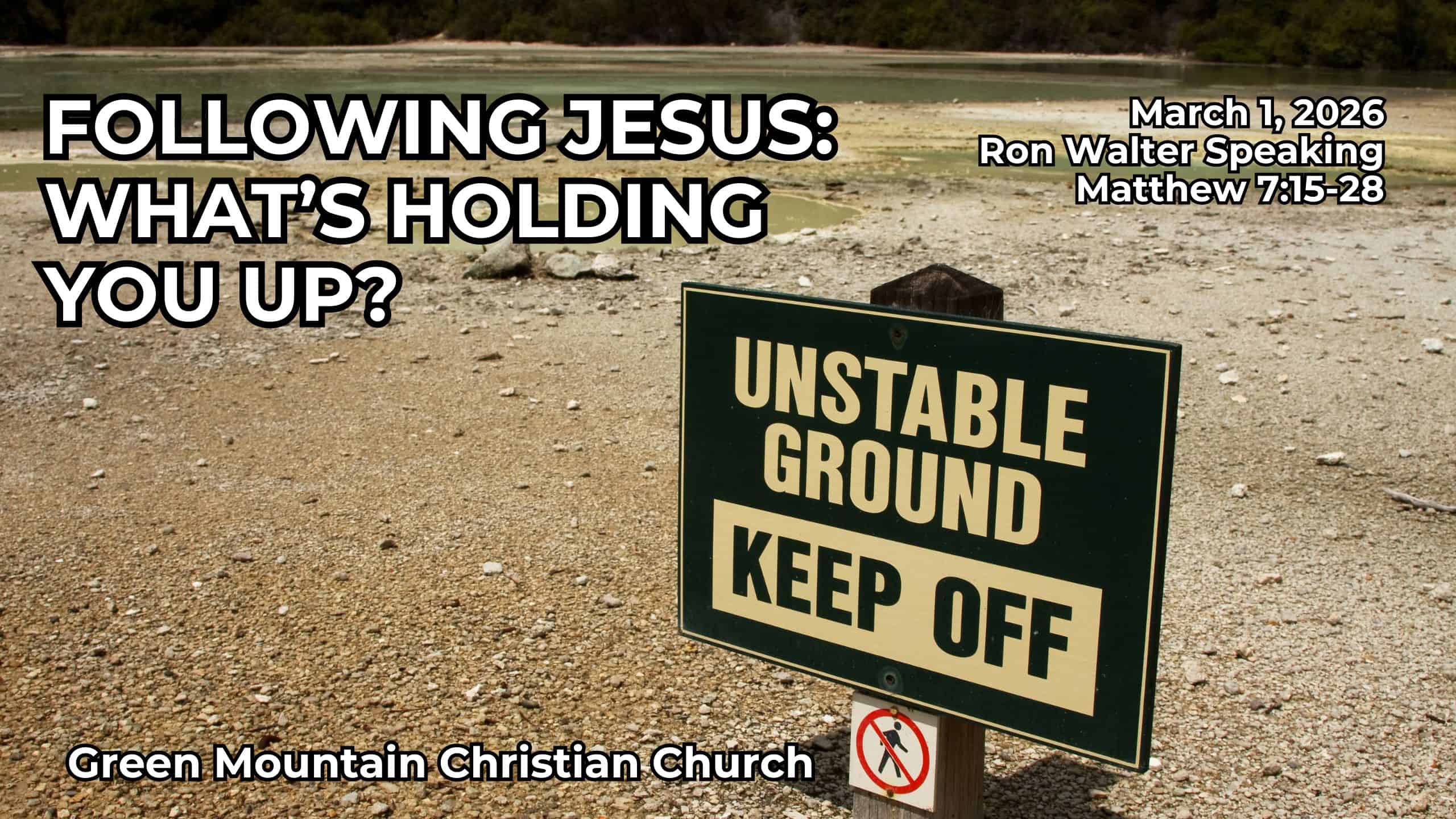
In Colorado, builders know to be wary of bentonite in the soil. Bentonite is a very unstable type of soil that can swell up when wet. It can wreak havoc on foundations.
What do we base our lives on? What motivates and drives our actions? Are we building on a foundation of following Jesus or on something that will ultimately topple?
Summing up the Sermon on the Mount
It’s helpful to look back on what the rest of the sermon has been saying.
Jesus started with blessings. The beatitudes were saying you’re blessed in many different situations, even ones that don’t feel like blessings. We recognize God’s presence and blessing in all aspects of life.
Jesus moved into a discussion of the things we always thought we were supposed to do. He raised the bar on the commandments we follow. He spoke of response to oppression and other interactions with others. In all of these He emphasized the heart of what we do is what truly matters.
Then He got into acts of righteousness. We pray, we fast, we give, but why do we do it? Is it for God and for others, or is it for ourselves?
Jesus moved into the different things that have meaning for us. What do we invest time and money into? What do we pay attention to, and what are the things we concern ourselves with? In the end, he teaches us to seek God’s kingdom, and God takes care of the details.
As He speaks of judgmentalism, He introduces the Golden Rule. It’s more or less the Great commandments: Love God with all you are, and love your neighbor as yourself.
A Common thread throughout the Sermon on the Mount
This is a hard sermon. Jesus taught hard things. That can confuse us, because we preach Grace, but Jesus sets the bar on our behavior higher, not lower. He demands more, not less.
“This sermon is dangerous because it shakes us awake. This world is broken, but we develop so many ways to cope with life that we lose sight of how broken it all is (including us). Jesus’ Sermon on the Mount shatters all of our illusions like glass. His stark portrayal of the way things should be lays bare the bankruptcy of the way things are. After reading this, the illusions are gone, and we know we can’t stay where we are…. This sermon is dangerous because reading it has consequences. It will sift you. You must respond one way or another, and the choice you make will echo into eternity.” – Jeremy Bacon: The Sermon on the Mount: 40 Days of Learning the Ways of the Kingdom
Jeremy Bacon: The Sermon on the Mount (40 Days of Learning the Ways of the Kingdom)
How do we reconcile this higher standard with grace?
The key here is to recognize that this isn’t about demanding more perfection. It’s not about being better or doing better.
In His sermon, Jesus constantly gets to the heart of what we do, how we live, and how we think. What is it behind our actions? It’s not as much about WHAT we do, but WHY we do it.
As we look at each section, we see Jesus constantly referring towards our heart. He speaks to the attitude. He speaks to the why. How do we view God? How do we view others?
Love God. Love others.
Jesus isn’t berating us for our actions. Our actions will never be enough. They can’t be. What He is doing is pointing us to a better way.
Love God. Love others.
That’s the foundation. That’s the narrow gate. The Great Commandment is ultimately the true message. When we love God and love others, that drives us to a life that seeks the will of the Father.
Following Jesuss is all about a foundation of love for God and for others.
The sermon is hard. The bar is high. It seems like an impossible standard, but it’s not really about the standard or the behavior or the actions.
It’s about loving God. It’s about loving others.