
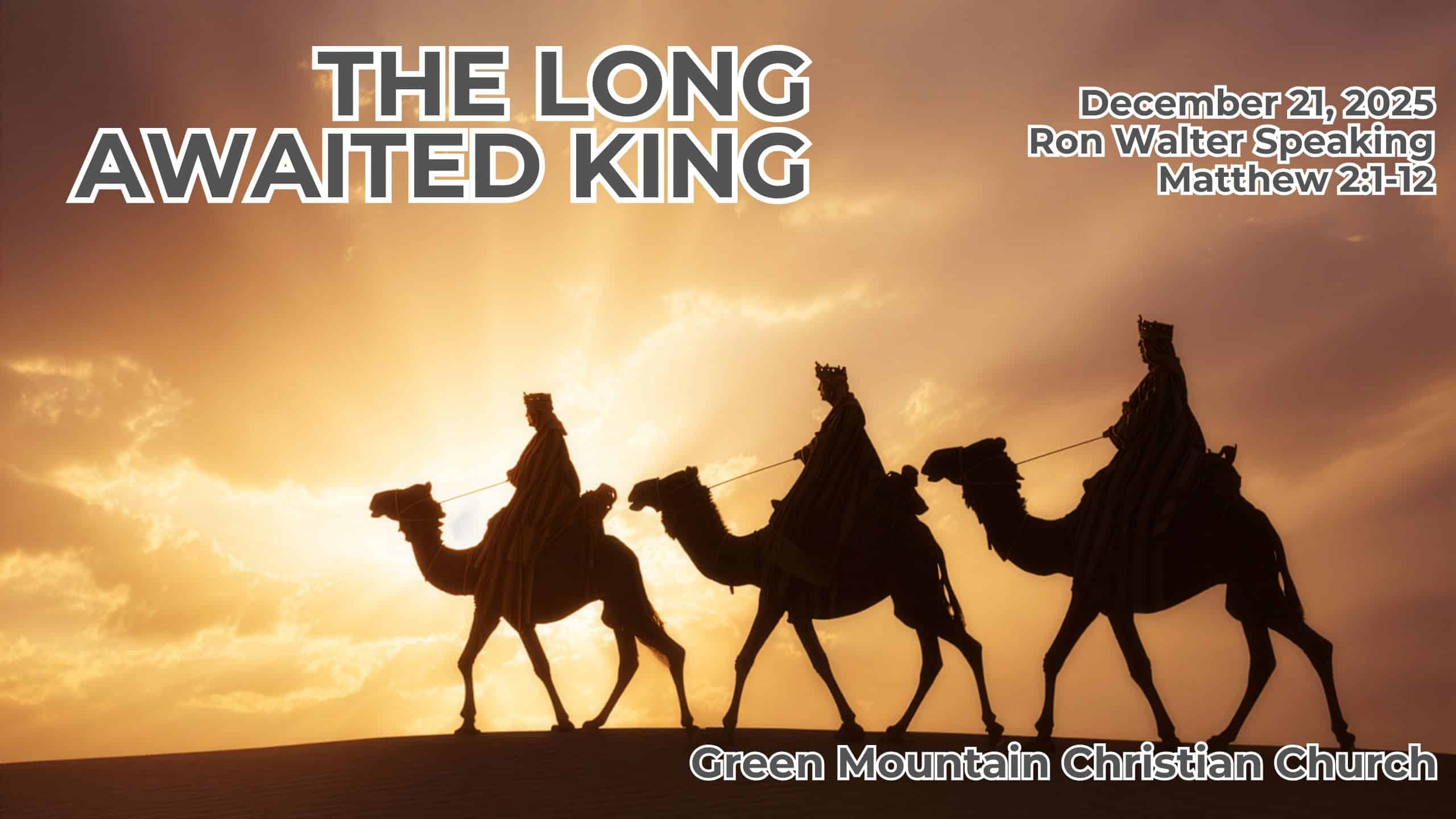
Waiting is a part of Christmas that you learn from the very beginning. You wait for school to get out. You wait for family get-togethers. And of course, you wait to open presents.
We become familiar with waiting in different ways as we grow older or for doctors visits and test results. We wait for the repair person to fix that broken appliance.
Here in Colorado, we just experienced some planned power outages. Some are still waiting for power to be restored.
Video:
Audio only
A Familiar Story of Waiting
One of the well known stories in the Bible related to Christmas time is one that highlights a different kind of waiting.
After Jesus was born in Bethlehem in Judea, during the time of King Herod, Magi from the east came to Jerusalem and asked, “Where is the one who has been born king of the Jews? We saw his star when it rose and have come to worship him.” When King Herod heard this he was disturbed, and all Jerusalem with him. When he had called together all the people’s chief priests and teachers of the law, he asked them where the Messiah was to be born. “In Bethlehem in Judea,” they replied, “for this is what the prophet has written:
“‘But you, Bethlehem, in the land of Judah, are by no means least among the rulers of Judah;
for out of you will come a ruler who will shepherd my people Israel.’”Then Herod called the Magi secretly and found out from them the exact time the star had appeared. He sent them to Bethlehem and said, “Go and search carefully for the child. As soon as you find him, report to me, so that I too may go and worship him.” After they had heard the king, they went on their way, and the star they had seen when it rose went ahead of them until it stopped over the place where the child was. When they saw the star, they were overjoyed. On coming to the house, they saw the child with his mother Mary, and they bowed down and worshiped him. Then they opened their treasures and presented him with gifts of gold, frankincense and myrrh. And having been warned in a dream not to go back to Herod, they returned to their country by another route.
Matthew 2:1-12 (NIV)
Who were the Magi?
The Bible doesn’t really tell us who the Magi were, other than that they came from the East.
In ancient literature, the word translated “magi” often referred to a tribe of the Medes that held to Persian religion. Some say they were to their religion what the Levites were to the early Jewish religion.
That word does show up once in the Old Testament, in the book of Daniel. Daniel was an exile from Jerusalem to Babylon when Nebuchadnezer conquered Jerusalem. The story tells how Nebuchadnezer had a disturbing dream but none of his “magi” could help interpret the dream.
Daniel enters the picture, tells the king’s dream to him and gives the interpretation. The king was so impressed that he put Daniel in charge of the magicians and seers.
Could the magi in Matthew be descendents of the magi in Daniel’s story? Is it possible that what Daniel taught these people was passed down through the ages?
After all, Babylon is due east of Jerusalem.
Micah’s prophecy comes to light
One thing we do know about these magi is they knew that scriptures pointed to the fact that God would send a king. They quoted Micah 5:2 when replying to Herod.
Whenever you read an Old Testament scripture quote in the New Testament, it’s always a good thing to read the context of that quote.
Marshal your troops now, city of troops,
for a siege is laid against us.
They will strike Israel’s ruler
on the cheek with a rod.“But you, Bethlehem Ephrathah,
though you are small among the clans[b] of Judah,
out of you will come for me
one who will be ruler over Israel,
whose origins are from of old,
from ancient times.”Therefore Israel will be abandoned
until the time when she who is in labor bears a son,
and the rest of his brothers return
to join the Israelites.He will stand and shepherd his flock
in the strength of the Lord,
in the majesty of the name of the Lord his God.
And they will live securely, for then his greatness
will reach to the ends of the earth.And he will be our peace
Micah 5:1-5a (NIV)
Micah existed before the fall of the Northern and Southern kingdoms of Israel. He warned in his writings that they would fall, that God would send conquerors. But then much like many of the prophets in the Old Testament, he offered a glimmer of hope.
Prophecy, Bible history, and a broken world.
There’s a common thread between Daniel and Micah and the arrival of the Magi in Jerusalem. The thread begins in Genesis and speaks of a broken world.
The break happens when Adam and Eve sinned. They were in Eden, living in a perfect world created by God. You could sum God’s response to their disobedience up in three words:
You broke it.
The rest of the Old Testament is the story of God working to put it all back together again. It’s the story of Him putting things into place to fix everything that was lost and broken.
God called Abraham to follow him and to be the father of a new nation. God eventually gave them a land he promised, and they developed a nation. David is notable as king of Israel.
Over time, things decayed. The nation divided into Israel (the southern kingdom) and Judah (the northern kingdom). Both nations gradually walked away from God.
Here’s where the prophets like Micah enter the picture: God sends men throughout history to warn Israel that they’ve broken their relationship with Him. These prophets would often write of condemnation and warn of calamity.
Waiting for what was broken to be fixed
Fast forward about 600 years from Daniel, and we get the story of the magi searching for a promised king.
There was growing anticipation and expectation that God would raise up a new king to rescue Israel. After centuries of subjugation under other kings and nations, people were expecting a savior to deliver them.
These Easterners were very aware of that expectation. They had it as well, to the point that when they saw the signs, they made a long trip to find this promised king.
They quoted Micah. By their expectations, I’m sure they were aware of several scriptures that pointed to this new king. If indeed they were influenced by teachings from Daniel, they’re probably aware of this passage.
In my vision at night I looked, and there before me was one like a son of man,[a] coming with the clouds of heaven. He approached the Ancient of Days and was led into his presence. He was given authority, glory and sovereign power; all nations and peoples of every language worshiped him. His dominion is an everlasting dominion that will not pass away, and his kingdom is one that will never be destroyed.
Daniel 7:13-14 (NIV)
The wait is over
It’s a lot like waiting for the repairman, isn’t it? The world was broken. The kingdom was broken. Our relationship with God is broken. All along, God has promised a king that would fix all of that.
I believe this is a point that helps us understand that whole situation. The wait is over. The king is here. The savior of the world has arrived and his kingdom will never be destroyed.
God has sent his King.
It was big news. Big enough that they couldn’t help but go search for this king. There was excitement and celebration that everything that had been promised has come true.
The wait is over.
What will you do with this promised king?
The reason they celebrated is the reason we can celebrate today. We’re in a broken world today. That’s obvious every time you open a newspaper.
Oppression still exists. People still hurt. We’re divided in so many ways. People are lonely. People are lost.
The life, death, burial and resurrection of that king that the Magi had been waiting for fixed the relationship with God. It gave us a way to relate to Him again and restore what was broken by our sin.
And that’s the key to why the world is still broken. Because God wants to give people the chance to accept that repaired relationship. The day will come when he takes us home to a place where everything else is restored.
But the question becomes: What do we do with this king?
Interestingly Jesus began his ministry with this statement:
“The time has come,” he said. “The kingdom of God has come near. Repent and believe the good news!”
Mark 1:15 (NIV)
This was very much like how a herald would go before a conquering king and announce that a new king is coming. It’s both a pronouncement and a warning.
The Greek word “pistis” was used here for believe. It’s also frequently translated as “give allegiance.”
The King is here. Give him your allegiance.
What will you do with this King?