

In college, my Opel had numerous starter problems. I often had to push start the car. In other words, I’d get the car moving, then put the car in gear. Since it was a manual transmission, that would turn the engine and often get it started.
If I parked on top of a hill, all I had to do was coast downhill, and then pop the clutch.
This worked great, unless of course, the car failed to start before I reached the bottom of the hill. If I’m at the bottom of the hill and no longer able to coast, what next? How do I get my car started now?
Video:
Audio only
That’s the thing about coasting, isn’t it? Coasting only works when there’s a hill to coast down.
There are a lot of ways we can coast in life. Maybe we coast with our health, until we get medical results that tell us we need to get more serious about diet and exercise. We might coast with our finances until the bank lets us know we’ve overdrafted our account.
We can also coast with our faith. It’s possible to coast as a congregation. It can leave us with a decision: Are we going to sit at the bottom of the hill, or do we step on the gas and get out of there?
We’ll look at a moment when there’s an understanding about who Jesus is that has some very deep implications. It begs the question of us: What do we do with who He is? Can we sit at the bottom of the hill with that knowledge?
Who Do We Say Jesus Is?
We just wrapped up a sermon series on the names of God.
Abram discovered God’s ability to do the impossible and called Him Adonai, sovereign Lord. Hagar discovered that God saw her, a runaway slave alone in the desert, and called Him El-Roi (God who sees me). God revealed that he loves his people passionately and deeply and that He is El-Kanna, a jealous God. Moses saw that God brought the victory and called him Jehovah-Nissi, God is my banner. Isaiah saw that God would come among us and called him Immanuel: God with us.
All these names of God prompt the question: Who do WE say that God is? Who is he to us? What will we do with who he is?
Jesus preparing his disciples for what’s next
In Matthew 16, Jesus asks his followers that same question: Who do you say that I am?
After a couple weeks together, it’s maybe 6-7 weeks from the crucifixion. Soon the disciples will have to transition from followers to leaders. They’ll go from watching Jesus to leading the way in declaring Him.
You have to wonder if they’re ready for this. To be honest, it doesn’t look that way.
Case in point: earlier in Matthew 16, Jesus is in a boat with them after going back and forth with religious leaders. He warns them to beware of the yeast of the Sadducees and Pharisees.
What do they do? Look at each other and ask if this is because they forgot to bring bread.
Watching the disciples often felt like adventures in missing the point. There was often a disconnect between what Jesus taught and where they were.
Coming into this passage, it seems like Jesus is focusing on preparing them for what comes next. They’re not here to just follow along. He has plans for something greater that he’ll reveal a part of shortly. He’ll be gone soon and it will be up to them to step up.
It’s in this atmosphere of preparation that Jesus asks an interesting question.
The question of who Jesus is
When Jesus came to the region of Caesarea Philippi, he asked his disciples, “who do people say that the Son of Man is?” And they replied, “some say John the Baptist. Others say Elijah, still others, Jeremiah or one of the prophets.” “But what about you?” he asked. “Who do you say I am?”
Matthew 16:13-15
It’s time to get real: Who do you say that I am?
What a question for us after studying the names of God! It’s one thing to know what others called Him, but who do we say that he is?
This isn’t about what we’re taught to say. It’s not about the things we memorized. It’s about what we really believe about who he is.
This is an incredibly important question. The answer will inform what we do going forward. It will determine how we live our lives. Who Jesus is to you makes all the difference in what we do and how we live. It’s a question we should never stop asking. Who do we say He is?
The ultimate answer to who Jesus is.
The Bible tells us Peter spoke up. That’s usually a time we brace ourselves for what comes next. How will he put his foot in his mouth this time? What will he get wrong? Is this the usual impetuous Peter?
But Peter nails it with his answer
Simon Peter answered, “You are the Messiah, the Son of the Living God.”
Matthew 16:16
Jesus will eventually say this was revealed by the Father. The thing is, Peter listened. Peter noticed. What an incredible answer: You are the Christ, the Messiah, the Son of the living God.
Some translations say Messiah, others say “the Christ.” Peter understood that this was the deliverer that his people have been waiting for who’s come to save God’s people.
Expectations of a Messiah
People in that day were longing for a deliverer to save them from Rome.
That’s what God had done so often. There was a cycle in the Old Testament:
- Israel falls away from God
- Another nation or group oppresses Israel
- Israel repents
- God raises up a deliverer
- Rinse and repeat.
After Israel split and fell and was carried off into captivity, the expectation of a deliverer renewed. That’s what God always did in the past, so why not now? Prophets alluded to a savior.
Now here we are, with Roman oppression. Things are happening again, God has broken a 400-year silence. Surely, this is the Messiah, the deliverer that God has sent.
The beauty of Peter’s confession
Peter not only recognized that this is the Christ. He recognized the deity of Christ. You are the son of the living God.
This is pretty much the gospel in a nutshell: You are God with us here to save us.
Peter’s declaration is like all the names of God from our last series rolled into one: The sovereign God who saw his people in distress, who loved them so passionately and jealously that he sent his Son as god with us, here to save us and become our banner.
What an incredible statement. You are the Messiah. The Son of the Living God.
The Implication of Who Jesus Is
Jesus replied, blessed on you, Simon, son of Jonah. But this was not revealed to you by flesh and blood, but by the Father in heaven. And I tell you that you are Peter, which means rock. And on this rock I will build my church.
Matthew 16:17-18a
Our first reaction to this passage is usually to debate whether “this rock” is Peter, his confession, or something else.
Unfortunately, we get so caught up in that debate that we miss that Jesus said he would build his church. Yes, God revealed this answer, and on this rock I will build my church.
This is Jesus preparing his disciples. A few weeks from when he’ll be killed, Jesus goes beyond simply that he’ll die, but he points to what happens after Jesus dies.
Whether “this rock” was Peter or his confession or whatever it was, the important thing here is, Jesus built his church.
Peter the fool
I read one commentary that said that Jesus could not have been referring to Peter here, because Peter was a fool.
He’s not wrong about Peter being the fool. He was impatient, impetuous and had a way of putting his foot in his mouth.
We saw that right after this passage. Later in the 16th chapter, when Jesus reveals he’ll be killed and raised to life, Peter takes him aside and says this will never happen.
What was Peter thinking? Did he think Jesus was getting discouraged, that the “son of the living God” was losing faith? Or did he think that “the Messiah” didn’t quite understand what being the Messiah was all about?
And how did Peter completely miss the part about being raised to life? That’s kind of an important detail.
It’s audacity like this that supports the idea that Peter was a fool.
A church built on fools
Let me ask you something. Was anyone that God used in the scriptures NOT a fool in same way, shape or form? Moses, Abraham, David, the other disciples, they all had their imperfections and follies.
Is it possible that God built his church on fools, sinners, broken people, and scoundrels?
Here’s something Paul had to say about the topic:
Brothers and sisters, think about what you were when you were called. Not many of you were wise by human standards. Not many of you were influential. Not many of you were of noble birth, but God chose the foolish things of the world to shame the wise. God chose the weak things of the world to shame the strong God chose the lowly things of the world and the despise things and the things that are not to nullify the things that are so that no one may boast before him.
1 Corinthians 1:26-29 NIV
Isn’t that God’s M.O.? He used people who had no business being “heroes of the faith” to do what he did.
Charles recently talked about the battle of the Amalekites where the military strategy was for Moses to hold up a stick. Who thought that made any sense?
God did things that didn’t seem to make sense. There was a reason for it: to show that it was the power of God, not the people.
Peter was a fool, but God had a way of building his church on fools, sinners, and broken people. I’m thankful that he does because I don’t know that I would fit in otherwise.
A church built on people willing to say yes to God
But there was another thing about Peter and the people that God used. While they were fools who often did reprehensible things in their lives, they also allowed God to use them. They made themselves available.
This brings us back to Peter. Freddie Hererra said this during our conversation on missionality:
I love the story, the Bible of Peter stepping out of the boat to walk on water. And we often focus on the fact that he stopped looking at Jesus and he started drowning. But I really liked the fact that he stepped out of the boat. The others stayed safely inside, but he had faith enough because he saw Jesus, and he went and walked on water. And then when he fell, (you know, we all do at some point), Jesus caught him.
Freddie Hererra during our Conversation on Missionality, February 26, 2024
We focus on Peter the Fool getting scared and sinking. We forget that Peter, a mere man, believed enough to walk on water.
Maybe the reason Peter said foolish things so often is that he put himself out there so often. He stepped out more and took chances.
Jesus built his church on fools who said yes to God.
The big picture of who Jesus is
and upon this rock, I’ll build my church and the powers of death will not prevail against it.
Matthew 16:18b RSV
Jesus used a Hebrew term from the Old Testament for the realm of the dead. He said death will not prevail against the church.
This was offensive terminology here. That death was on the march, death was on the attack, but Jesus said that it will not conquer His church.
This is a powerful clarification of exactly who the Deliverer is here. The Messiah is indeed a deliverer, here to save his people. But the oppressor is not Rome. Death is the oppressor. Death is the one the Messiah is here to stop.
I will build my church, and death will not conquer it.
Peter’s Messiah vs the Real Messiah
Peter’s answer to “who do you say I am?” was spot on. However, his confusion when Jesus revealed he’d be killed and raised to life shows he never fully understood that answer.
Peter probably believed like everyone else at the time, that the Messiah would deliver Israel from Roman occupation. That’s why his confusion later: a Messiah can’t Messiah if he’s dead.
But what if Peter got his way? What if the Messiah came to liberate his people from Rome, like God had done time and time again in the past?
Think about it: How many times did God have to send a deliverer in Judges? There was always another oppressor to come along. How long will this freedom from Rome last? 50 years? 100 years? There would eventually be another oppressor.
And what about other people who were also under Roman oppression? Would Peter’s Messiah deliver them? Or were they just out of luck?
Peter was thinking temporary, caring only about his time. Jesus is thinking permanent. Peter thought only of his people. Jesus came to deliver all people. Peter thought small. Jesus was here for the biggest oppressor: death itself.
Understanding our roles
Death is coming. It’s coming for all of us, and for all those around us.
I don’t know about you. I can’t stop death. I’m pretty sure none of us can. A worldwide convention of all believers can’t figure out how to stop death.
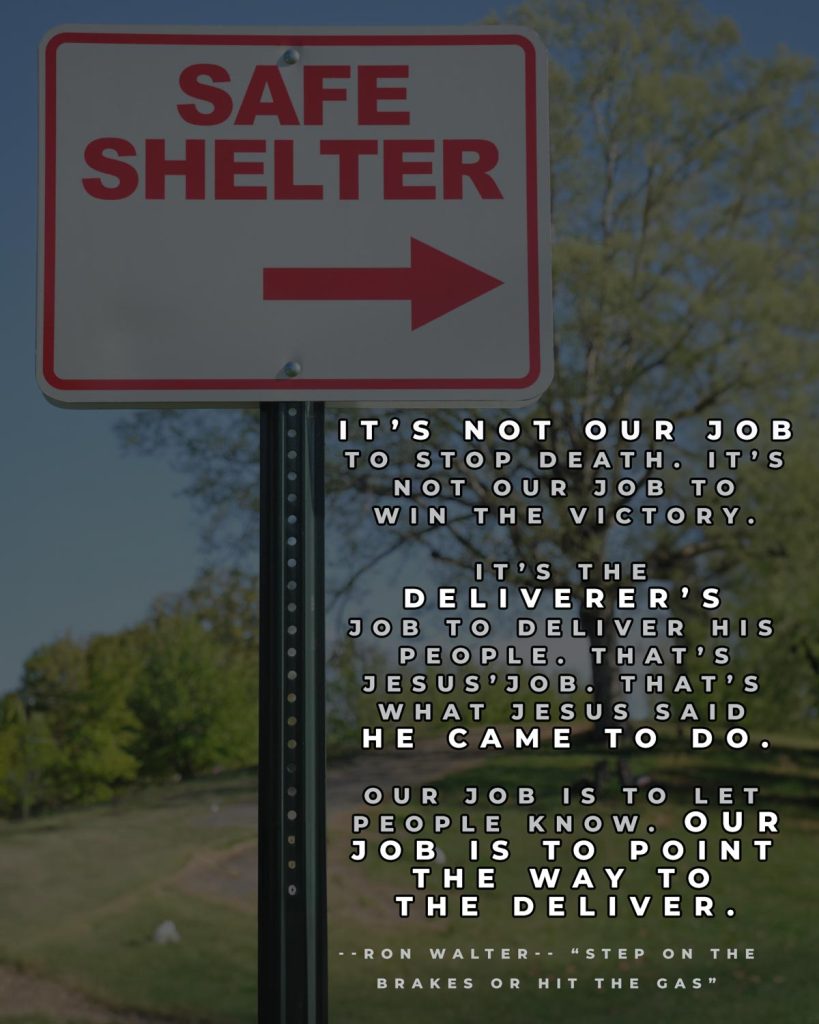
The thing is, that’s not our job. That’s the deliverer’s job. The Messiah is here to stop death. Jesus came to save, to set us free. That’s His job.
Our job is to let people know. Our job is to point the way to the deliverer.
It’s like a natural disaster where first responders point the way to safety. “Come over to here, here’s high ground. This is where you’ll be safe.”
Jesus is the Christ, the Son of the Living God. He’s the deliverer, here to deliver us from death.
Sitting at the bottom of the hill
When we understand the gravity and truth of who the Messiah is, we have to ask this question:
What do we do with that?
What does it mean to us?
If we really believe he’s the Messiah, can we really coast with our faith? Can we be content to sit in a club for other delivered people, do our church things, and not try to let other people know that there’s safety from the oppressor?
It’s an incredibly important question: Who do you say Jesus is?
Just as important is the reaction we have to the answer. If we really believe he is who we say he is, what do we do with that belief?
It’s not an answer that lets us coast. You can’t believe that he’s here to stop death and sit stuck at the bottom of the hill.
Maybe we’re not sure what it means to hit the gas or to not coast with our faith. I’m not sure I have the answer to that question, but I want to suggest four things to think and pray about:
1. Saying “here am I Lord.”
There were two common denominators in the people God used. One, they were sinners. Two, they made themselves available. They stepped out on faith. We can do both.
2. Have a missional mindset.
We can adopt a mindset that says, we’ve been sent on a mission by God for his glory. That means speaking, acting, thinking, and living through the lens of “how does God want to use me?”
3. Have a prayerful heart check
Ask God, where am I in this? Am I coasting? Am I standing in the way of being able to do anything? Is my attitude that I want to stay in my own group of people and be comfortable, or am I willing to step out and serve you?
4. Ask God to point the way
While you’re praying about where you stand, ask him to open your eyes to the people who need to know the message. Is it family, or friends, or co-workers? Who needs to know about the deliverer?
This is the Christ, this is the Messiah, this is God who came to be with us, who gave his life to be the deliverer, to defeat death.
When you really let that sink in, when you really take in who Jesus is, you can’t escape these two questions:
Who do YOU say that He is?
What will you do with who He is?